They both struggle with reading — but the reasons are fundamentally different. Understanding the distinction is the first step toward the right support.
- 1 in 10 people worldwide have dyslexia
- 80% of learning disabilities are dyslexia
- ~70% of slow readers catch up with support
The Question Every Parent & Educator Asks
A child who reads haltingly, stumbles over words, and falls behind peers — is it just a slow start, or is it something deeper? The distinction between a slow reader and a child with dyslexia is one of the most important questions in education, because the answer changes everything about how to help.
Both a slow reader and a dyslexic reader may appear similar on the surface. Both take longer to finish a passage. Both may avoid reading aloud. Both can fall behind academically. But the underlying mechanisms are entirely different — and so are the solutions.
The core difference: Slow reading is a pace issue — the child processes text accurately but takes longer. Dyslexia is a decoding issue rooted in how the brain processes the relationship between sounds and written symbols.
What Is Slow Reading?
Slow reading refers to a child who reads at a pace below their grade level without a specific neurological cause. These children can decode words correctly — they simply do it more slowly than typical readers. Slow reading is usually temporary and responsive to conventional interventions.
Common causes of slow reading
- Environmental factors: limited exposure to books at home, fewer opportunities for reading practice, or a language-delayed household can all contribute to a later start in reading fluency.
- Developmental timing: children develop at different rates. A child who is young for their grade may simply need more time, particularly with complex phonics rules.
- Processing speed: some children have slower general processing speed — they take longer to absorb and respond to all types of information, not just text.
- Attention & motivation: difficulty focusing, anxiety around reading performance, or low interest in reading material can slow a child who otherwise has the cognitive tools to read well.
What Is Dyslexia?
Dyslexia is a specific learning difference with a neurobiological origin. It is characterised by difficulty with accurate and fluent word recognition, poor spelling, and weak decoding ability. These difficulties stem from a deficit in the phonological component of language — the ability to identify and manipulate the individual sounds (phonemes) within words.
Critically, dyslexia has nothing to do with intelligence. Children with dyslexia are often highly intelligent and creative thinkers who happen to have brains that process written language differently.
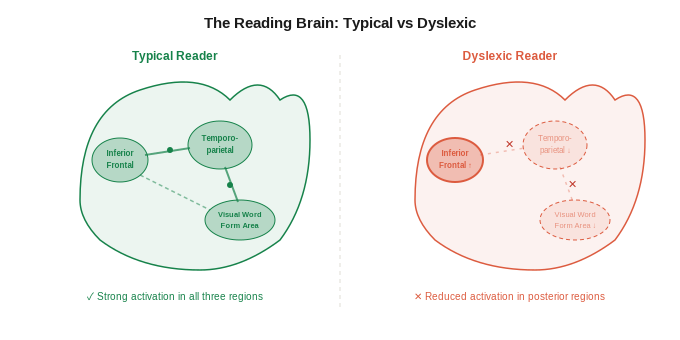
Neuroimaging research has revealed that individuals with dyslexia show fundamental differences in brain regions linked with reading and language. These differences are primarily noted in the left hemisphere. The temporo-parietal region, which integrates phonology and visual letter patterns, and the occipito-temporal region (the "visual word form area"), which supports rapid letter and word identification, both show reduced activation. Meanwhile, the inferior frontal region often shows increased activation, suggesting the brain is compensating by working harder at the front.
These neural differences are present long before children learn to read. Infants who are later diagnosed with dyslexia already show measurable differences in how their brains respond during phonological processing tasks — a finding that underscores the genetic and neurobiological nature of the condition.
Side-by-Side: How They Differ
| Slow reader | Dyslexic |
|---|---|
| Reads words correctly but at a slower pace | Struggles to decode words accurately, not just slowly |
| Can sound out unfamiliar words, just takes longer | Difficulty connecting letters to sounds (phonological deficit) |
| Comprehension is usually intact when given time | Comprehension is often impaired by decoding effort |
| Spelling is generally age-appropriate | Persistent spelling difficulties and letter reversals |
| Responds well to increased reading practice | Does not improve with general reading practice alone |
| Usually catches up with peers over time | Requires specialised, structured intervention |
| No underlying neurological differences in reading circuits | Measurable differences in brain activation patterns |
Warning Signs: What to Watch For
Early identification makes a significant difference. Here are the signs across different age groups that distinguish dyslexia from typical slow reading development.
| Age group | Slow reader signs | Dyslexia signs |
|---|---|---|
| Pre-school (3–5 yrs) | Limited interest in books; smaller vocabulary from less exposure | Difficulty learning nursery rhymes; trouble recognising letters of own name; family history of reading difficulties |
| Early school (5–7 yrs) | Reads haltingly but self-corrects; slow but steady progress | Persistent letter/number reversals (b/d, p/q); can't blend sounds into words; avoids reading aloud |
| Primary (7–11 yrs) | Below grade level but closing the gap; comprehension is strong | Reads far below grade level despite effort; poor spelling; strong verbal skills but weak written expression |
| Secondary (11+ yrs) | May still be a bit slow but functionally competent | Avoids reading and writing tasks; difficulty with foreign languages; slow, laborious homework despite intelligence |
Different Roots, Different Solutions
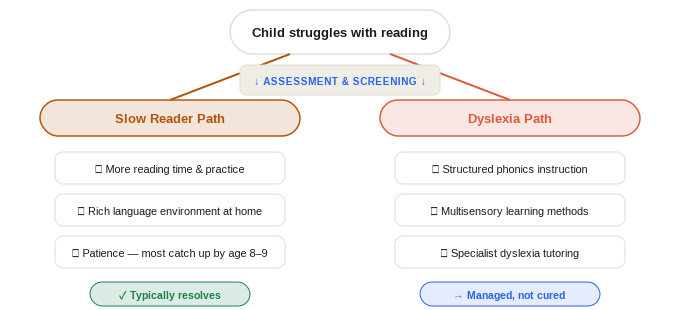
Because the causes differ, the interventions must differ too. Applying the wrong approach wastes critical time — especially in the early years when neuroplasticity is greatest.
For slow readers
The approach is straightforward: create more opportunities. A richer language environment at home, more time spent reading aloud with a supportive adult, access to engaging books at the right level, and patience. Most slow readers respond well to guided oral reading, paired reading, and simply having more time with text. The prognosis is excellent — the majority catch up to their peers within a year or two.
For children with dyslexia
General reading practice alone will not solve the problem. Children with dyslexia need structured, systematic, and explicit instruction in phonological awareness — the ability to hear, identify, and manipulate the sounds within words. Programmes based on the Orton-Gillingham approach, which uses multisensory techniques (seeing, hearing, touching, and moving) to teach the connections between letters and sounds, have the strongest evidence base.
With the right intervention, children with dyslexia can learn to read. It doesn't come naturally, and it requires sustained effort, but the brain can form new pathways. The critical factor is early identification and appropriate, targeted support.
Why early screening matters: The brain is most plastic in the first few years of school. Intervention at age 5–6 is significantly more effective than the same intervention at age 9–10. Every year of delay is a year of widening gaps — not just in reading, but in confidence, vocabulary, and academic self-concept.
Dyslexia Is a Difference, Not a Deficit
It is vital that children with dyslexia understand they are not slow, lazy, or unintelligent. Dyslexia is a brain-based difference in how written language is processed. Many people with dyslexia show exceptional strengths in areas such as spatial reasoning, creative thinking, pattern recognition, and problem-solving.
The narrative around dyslexia is shifting — from a "disability" framing toward a neurodiversity perspective that recognises the unique cognitive profile that comes with it. The challenge is in reading; the strengths often lie elsewhere.
When in Doubt, Screen Early
If a child has been struggling with reading for six months or more without improvement, a screening can provide clarity — and open the door to the right kind of help. DysTest combines webcam eye tracking with rapid naming, reading and spelling tasks to look for patterns associated with dyslexia, in about 20 minutes on a laptop or desktop at home or at school. It is a screening, not a diagnosis.
Sources & References
- National Center on Improving Literacy — Neurological Considerations for Dyslexia (2026)
- Norton, Beach & Gabrieli — Neurobiology of Dyslexia, MIT (2014)
- D'Mello & Gabrieli — Brain Basis of Dyslexia, Purdue University (2018)
- British Dyslexia Association — Rose (2009) Definition of Dyslexia
- Understood.org — Learning Differences That Affect Reading
- HealthXchange — Dyslexia: A Common Learning Disability in Children
- Children's Health Council (CHC) — Is Your Child a Slow Reader or Dyslexic?