1. Introduction
Every gaze-calibration session on this platform begins with no information about the subject: the Thin-Plate Spline model described in Thin-Plate Spline Gaze Calibration with Adaptive Per-Point Regularization (this series) is fitted from scratch, per session, from sixteen calibration points collected in that session alone. As the platform accumulates calibration sessions across its user population, an obvious question arises: can knowledge aggregated across many prior sessions improve calibration for a new user, before that user has provided any data of their own? This paper describes a population-prior warm-start architecture designed to answer yes, subject to a safety property that makes it deployable without risk of making any individual session worse.
2. Why Per-Session TPS Coefficients Are Not Directly Averageable
The most direct approach — averaging the fitted TPS radial-basis-function weights across many users' calibration sessions — does not work, because those weights are defined relative to each session's own basis centres: the z-score-normalised iris-offset coordinates of that session's sixteen calibration points. Two different subjects' iris geometry, camera angle, and seating distance produce different basis centres, so their RBF weight vectors are not commensurable; averaging them would not correspond to any meaningful aggregate model. Any quantity intended for population-level aggregation must therefore be one that is not tied to a specific session's basis centres.
3. The Affine Component as the Averageable Quantity
The platform's full correction pipeline (described in §3.3 of the TPS paper in this series) applies, after the TPS evaluation itself, a sequence of further corrections: a head-pose ordinary-least-squares correction, an optional quick-affine recalibration layer, and a post-validation affine layer fitted from the eight-point validation phase that follows calibration. Each of these later layers operates in screen space — its inputs and outputs are normalised screen coordinates, not session-specific iris-offset coordinates — which makes them commensurable across sessions in a way the TPS weights are not. The population prior described here takes the same form: a three-coefficient affine correction [a0, a1, a2] per screen axis, of the same shape as the existing quick-affine and post-validation-affine layers, computed by the backend as a population-level aggregate.
4. The Warm-Start Pipeline
4.1 Acquisition
On mounting the camera-setup page, before calibration begins, the platform issues a request to a population-prior endpoint, parameterised by the subject's declared age tier and language (since iris geometry and likely camera setups plausibly differ systematically across these groups, and an age/language-specific prior is a better starting point than one global average). The request is fire-and-forget: failures, including the expected 404 response during early rollout before the backend has accumulated enough sessions to return a meaningful aggregate, are silent and leave the platform in its pre-existing, fully-functional no-prior state.
4.2 Application
If a prior is returned, it is stored as [priorCoefficientsX, priorCoefficientsY] and applied as an affine correction immediately after the TPS-or-fallback estimate is computed, before the head-pose correction and any later person-specific layer — both in the main per-frame calibration pipeline and in the iris-geometry-only fallback gaze estimate used by the calibration UI's proximity gate (so that the population prior, where available, improves not only the final calibrated gaze but the dot-collection gating that determines calibration data quality in the first place; see §5 of the TPS paper).
4.3 The safety property
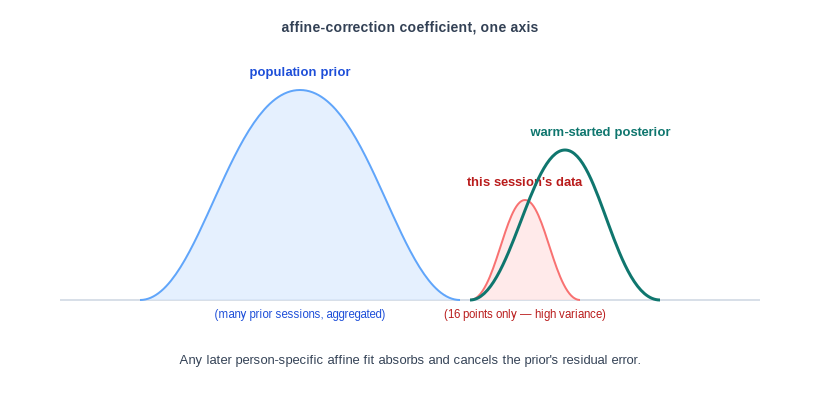
The central design property that makes this architecture safe to deploy without first proving the prior's accuracy on a held-out population is this: any later person-specific correction layer — most importantly the post-validation affine layer, fitted by ordinary least squares against the eight-point validation observations after the population-prior correction has already been applied — is fit against whatever the pipeline outputs at that point, population-prior correction included. If the population prior introduces a systematic error for a given user, the post-validation affine fit will learn to compensate for that exact error, because it is fitting against the already-corrected output, not against some hypothetical uncorrected baseline. The population prior can therefore only ever help — narrowing the gap the person-specific layer has to close — or be entirely cancelled out by the person-specific layer; it cannot make the final, fully-corrected gaze estimate worse than the no-prior baseline, once a person-specific correction layer is available. Before a person-specific layer is available — i.e., during the calibration-training phase itself — the prior is still a strictly weak nudge bounded by the same affine-coefficient magnitude the existing quick-affine layer already uses safely in production.
5. Backend Aggregation
The backend accumulates, per completed calibration session, the session's iris observations, fitted TPS coefficients, LOO-CV and validation errors, and context (screen dimensions, face distance, age tier, language, device). The population-prior endpoint aggregates the affine residual — the systematic screen-space correction that high-quality sessions' own post-validation affine layers found necessary — across all qualifying sessions matching the requested age tier and language, returning the resulting mean coefficients once a minimum session-count threshold (approximately two hundred high-quality sessions, in current configuration) is met for that age/language stratum; below this threshold, the endpoint returns 404 and the platform proceeds with no prior, exactly as it did before this architecture existed.
6. Discussion
This architecture is intentionally conservative: it transfers only the linear, screen-space-averageable component of session-to-session knowledge, leaving the genuinely person-specific non-linear mapping to be learned, as before, from each user's own sixteen-point calibration. A more aggressive design — for instance, a hierarchical Bayesian model placing an informative prior directly on the TPS weights in a shared, registration-aligned basis — could in principle transfer more information, at the cost of requiring a basis-alignment step between sessions that the current architecture avoids entirely by restricting the transferred quantity to screen space. The current design was chosen specifically because its safety property (§4.3) can be stated and verified without reference to how good the population aggregate actually is, which matters operationally for a clinical-adjacent product where a calibration regression is a more serious failure mode than a calibration improvement left un-captured.
7. Conclusion
By restricting cross-session knowledge transfer to the one component of the calibration pipeline that is genuinely averageable across users — a screen-space affine correction, of the same form already used for purely person-specific corrections — and by applying it at a pipeline stage that any later person-specific correction layer will necessarily compensate for, population-prior warm-starting can be deployed with a population aggregate of unknown quality and is, by construction, unable to regress calibration accuracy once a person-specific correction is available.
References
- Gelman, A. et al. (2013). Bayesian Data Analysis (3rd ed.). CRC Press. [Hierarchical priors and partial pooling]
- Pan, S. J., & Yang, Q. (2010). A survey on transfer learning. IEEE Transactions on Knowledge and Data Engineering, 22(10), 1345–1359.
- Krafka, K. et al. (2016). Eye tracking for everyone. CVPR 2016. [Population-scale appearance-based gaze datasets and cross-subject generalisation]
Appendix A — Pipeline Ordering
1. TPS evaluation (or pre-calibration iris-offset fallback)
2. Population-prior affine correction       ← this paper
3. Head-pose OLS correction
4. Quick-affine recalibration (optional)
5. Post-validation affine correction (fitted after step 2's effect is already present)
6. Two-stage smoothing (median filter, then adaptive low-pass filter)
Appendix B — Endpoint Contract (Summary)
| Request | age_tier, language (optional query parameters) |
|---|---|
| Success response | { meanCoefficientsX: [a0,a1,a2], meanCoefficientsY: [a0,a1,a2], sessionCount, ageTier, language } |
| Insufficient data | HTTP 404 — treated identically to a network failure; no prior applied |
| Failure handling | All failures silent; calibration proceeds with no prior |