1. Introduction
Rapid Automatized Naming (RAN) — first formalised by Denckla and Rudel (1976) — asks a subject to name, as quickly as possible, a repeating sequence of familiar stimuli (letters, digits, colours, or objects) arranged in a grid. Naming speed on this simple task is among the most robust single behavioural predictors of decoding-based reading difficulty across languages and orthographies, robust enough that RAN performance alone predicts later reading outcomes before formal reading instruction has begun. Traditional administration requires a trained examiner to time each row with a stopwatch and score errors by ear in real time. This paper describes a browser-administered RAN battery that replaces the examiner's stopwatch and ear with row-advance gating and automatic-speech-recognition scoring, while preserving the row/grid structure of the traditional task.
2. Battery Structure
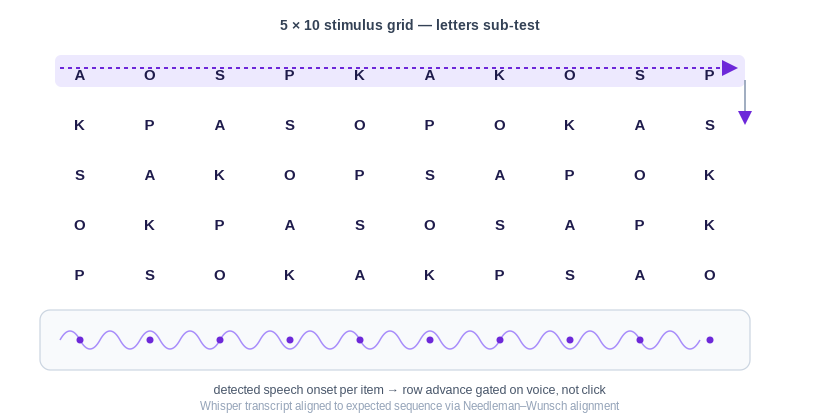
The platform administers four RAN sub-tests in a fixed protocol: RAN-L (letters: a five-symbol alphabet repeated across the grid), RAN-D (digits), RAN-C (colours, named aloud rather than read), and RAN-O (objects, named from line-drawing icons). Each sub-test presents a five-row, ten-column grid (fifty items total) drawn from a small fixed symbol set repeated in pseudo-random order, following the traditional RAN design in which the limit on naming speed is retrieval fluency for a known, small symbol set rather than novel stimulus recognition.
3. Administration Protocol
3.1 Row-by-row pacing under examiner (or self) control
The subject names one row aloud, then advances to the next row via an on-screen control. A row-skip prevention mechanism — a synchronous, ref-based lock engaged the instant the advance control is activated and released only once the row transition has actually completed — closes a specific failure mode observed in early versions of the task: a double-click or rapid double-tap on the advance control, common among young children, could fire two row-advance events before the first event's state update had been applied, silently skipping a row's data entirely. Because React state updates are not applied synchronously within an event handler, a boolean state guard checked at the top of the same handler can still read its pre-update value on the second, near-simultaneous click; a plain mutable reference, updated synchronously in the same tick the first click is handled, closes this race unconditionally.
3.2 Voice-detection gating
A second administration safeguard requires that audio actually be detected for the current row before the advance control will register: the platform records each row via the browser's MediaRecorder API and inspects the resulting audio blob's size before permitting advancement, rejecting blobs below an empirically chosen byte threshold (corresponding to roughly half a second of speech-level audio, distinguishing genuine silence or a mis-click from an attempted reading). A row rejected on this basis is not discarded; the row timer resets and the subject is prompted to read the row aloud before the advance control unlocks, ensuring that every scored row corresponds to an actual naming attempt rather than a click made without reading.
4. Automatic Speech-Recognition Scoring
4.1 Transcription
Each row's recorded audio is submitted to a Whisper-based transcription service, with the row's expected stimulus sequence passed as a decoder prompt/initial-prompt bias — a technique that substantially improves recognition accuracy for the isolated, decontextualised single-symbol utterances ("a", "o", "s"...) that RAN naming produces and that general-purpose speech recognition, tuned for conversational utterances, otherwise handles poorly.
4.2 Alignment
The recognised word sequence rarely has the same length as the expected sequence — a missed item produces a deletion, a misnamed item produces a substitution, and recognition noise can produce spurious insertions not corresponding to any expected item. The platform aligns the recognised sequence against the expected sequence using a Needleman–Wunsch-style global sequence alignment, which finds the lowest-cost edit path between the two sequences and classifies each expected position as correct (recognised token matches expected), substitution (a different token was recognised at that position), or deletion (no corresponding token was recognised), while absorbing extra recognised tokens as insertions that do not displace the alignment of the remaining expected positions. This alignment-based approach is materially more robust than naive positional comparison, which would mis-score every item after a single insertion or deletion as a cascading false substitution.
4.3 Error-corrected speed
Raw naming speed (items per second) rewards a subject who names quickly but inaccurately over one who names more slowly but correctly, which inverts the clinical signal RAN is meant to capture — fluent, automatic naming is fast and accurate, and a speed metric blind to errors cannot distinguish genuine automaticity from rushed guessing. The platform therefore reports an error-corrected speed metric that discounts raw items-per-second by the count of substitution and deletion errors (each scored against the alignment of §4.2), and separately reports the raw assessor-observed error count as a secondary, examiner-facing figure, allowing both the corrected clinical metric and the uncorrected raw count to be inspected.
4.4 Within-row timing consistency
Beyond mean speed, the platform records per-row timing and computes the coefficient of variation (standard deviation divided by mean) of row timings within a sub-test, as a secondary marker: a subject whose row times vary widely — fast on some rows, markedly slower on others — is exhibiting inconsistent retrieval fluency, a pattern reported in the dyslexia literature as itself diagnostically informative independent of mean speed, and blended into the variant's z-score alongside the error-corrected speed metric (see A Multi-Domain Composite Z-Score Model, this series, §3.1).
5. Discussion
Automatic-speech-recognition scoring trades the perfect reliability of a trained human examiner's real-time judgement for scalability and consistency: every administration is scored against the same alignment algorithm and the same age-and-language-appropriate norms, removing examiner-to-examiner scoring variance entirely, at the cost of occasional transcription error that a human listener would not make (most commonly, near-homophone confusions in noisy recording conditions). The platform mitigates this by retaining the raw audio recording associated with every row (see also the export-pipeline discussion of audio retention elsewhere in the platform's documentation) and by re-attempting transcription in a batch pass at export time for any row whose live, synchronous transcription did not complete successfully — for instance, because a transcription provider was transiently unavailable during the live session.
6. Conclusion
By combining synchronous row-skip prevention, voice-detection-gated advancement, Whisper-based transcription biased toward the expected stimulus vocabulary, and Needleman–Wunsch sequence alignment for error classification, the platform administers a four-variant Rapid Automatized Naming battery in an unsupervised browser context with scoring fidelity intended to approximate trained-examiner administration, while removing the requirement that a human examiner be present and listening in real time.
References
- Denckla, M. B., & Rudel, R. G. (1976). Rapid "automatized" naming (R.A.N.): dyslexia differentiated from other learning disabilities. Neuropsychologia, 14(4), 471–479.
- Norton, E. S., & Wolf, M. (2012). Rapid automatized naming (RAN) and reading fluency. Annual Review of Psychology, 63, 427–452.
- Needleman, S. B., & Wunsch, C. D. (1970). A general method applicable to the search for similarities in the amino acid sequence of two proteins. Journal of Molecular Biology, 48(3), 443–453. [Sequence alignment algorithm]
- Radford, A. et al. (2023). Robust speech recognition via large-scale weak supervision. Proceedings of the 40th International Conference on Machine Learning (Whisper).
Appendix A — Sub-Test Stimulus Sets
| Variant | Stimulus set | Naming modality |
|---|---|---|
| RAN-L | 5-letter repeating alphabet | Read aloud |
| RAN-D | 5-digit repeating set | Read aloud |
| RAN-C | 5 colours | Named from colour swatch |
| RAN-O | 5 objects | Named from line-drawing icon |
Appendix B — Alignment Classification Example
Expected:   a  o  s  p  k  a  o  s  p  k
Recognised: a  o     p  k  a  o  s  p  g

Alignment:
  a → a   correct
  o → o   correct
  s → ∅   deletion
  p → p   correct
  k → k   correct
  a → a   correct
  o → o   correct
  s → s   correct
  p → p   correct
  k → g   substitution
Appendix C — Voice-Detection Threshold
The platform rejects a row's recorded audio blob as "no voice detected" when its size falls below approximately 2 KB at the WebM/Opus encoding used by the browser's MediaRecorder — a threshold set well above the 100–400 bytes typically produced by half a second of ambient silence, and well below the 2–8 KB typically produced by half a second of speech-level audio at the same encoding.