1. Introduction
Strabismus — a misalignment of the two visual axes such that the eyes do not point at the same target simultaneously — affects an estimated 2–4% of children, with higher reported rates among children referred for learning and reading-difficulty assessment than in the general population. A webcam-based assessment platform that silently degrades or excludes strabismic subjects would therefore introduce a systematic equity problem rather than a rare edge case. This paper specifies how the platform's pupil-based distance and fixation tracking pipeline is adapted to remain valid for strabismic subjects, and the engineering principle — strict separation of binocular geometry from monocular perception — that makes this possible without a separate code path for affected users.
2. Clinical Background
Strabismus is classified along several independent axes relevant to this design:
- Direction: esotropia (inward deviation), exotropia (outward), hypertropia/hypotropia (vertical).
- Laterality: unilateral (one eye consistently deviates) or alternating (the deviating eye switches, sometimes spontaneously, sometimes with fixation preference).
- Concomitancy: concomitant strabismus has a deviation angle that is constant across gaze directions; incomitant strabismus (often of neurological or muscular origin) has a deviation that varies with gaze direction.
A critical perceptual consequence, particularly in long-standing or early-onset strabismus, is suppression: the visual cortex down-weights or actively suppresses the image from the deviating eye to avoid diplopia (double vision), so that perceived gaze direction corresponds to the non-deviating eye's line of sight, not the binocular average. Any gaze-estimation system that averages the apparent gaze direction of both eyes will therefore misestimate fixation for a strabismic subject in proportion to the deviation angle — a systematic, clinically meaningful error, not noise.
3. Design Principle: Geometry Is Binocular, Perception Is Monocular
The platform's central design rule for handling strabismus is a strict separation of two computations that are superficially similar (both consume the same iris landmarks) but answer different questions:
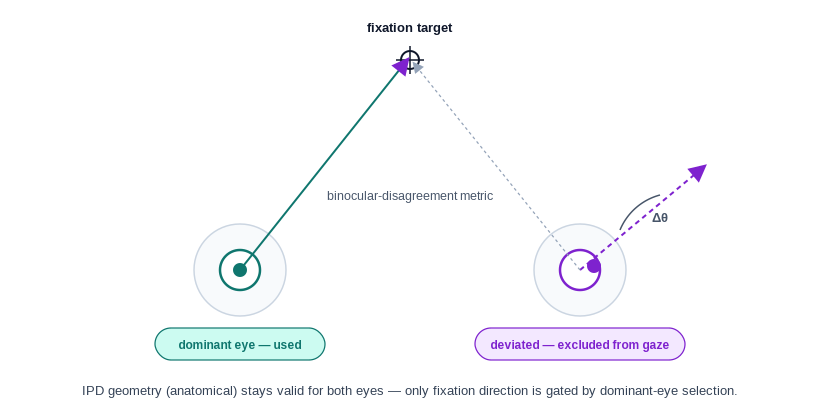
- Binocular geometry (used for Inter-Pupillary-Distance-based distance estimation; see Inter-Pupillary Distance–Based Depth Estimation, this series) measures the physical separation between the two iris centres. This quantity remains anatomically valid regardless of whether the visual axes are aligned — IPD is a property of skull anatomy, not of where either eye is looking — so distance estimation requires no strabismus-specific handling at all.
- Fixation and gaze direction are derived exclusively from a single, dynamically identified dominant eye, never from a binocular average. This is the one place strabismus handling must be explicit, because a strabismic subject's dominant eye is the only one whose line of sight reliably corresponds to perceived fixation.
4. Dominant-Eye Identification
4.1 Binocular disagreement as a detection signal
The platform computes a per-frame horizontal iris-offset value for each eye independently (the same lox/rox quantities used in gaze calibration; see Thin-Plate Spline Gaze Calibration, this series). Under normal binocular vision, fixating a single target produces left- and right-eye offsets that agree closely, because both visual axes converge on the same point. A sustained disagreement between lox and rox beyond what convergence geometry at the subject's working distance would predict is the platform's primary signal of probable strabismus, surfaced as an inter-eye agreement gate already present in the iris-geometry pipeline (computeIrisOffset discards a frame outright when binocular horizontal disagreement exceeds 0.8 eye-widths, the threshold also used to reject blink artefacts, since both produce a similar signature of one eye's measurement becoming unreliable relative to the other).
4.2 Selecting the dominant eye
When sustained disagreement indicates probable strabismus rather than a transient artefact, the platform does not attempt to estimate the deviation angle or correct for it numerically — doing so would require knowing the suppression state of the visual cortex, which is not observable from external imaging. Instead, it falls back to using whichever eye's measurements have shown the more stable, internally consistent fixation pattern across the session, on the clinical rationale that sighting dominance — the eye whose input is preferentially used for monocular tasks — is overwhelmingly likely to be the non-suppressed eye in cases of long-standing strabismus. This selection is held for the remainder of the session rather than re-evaluated every frame, since dominant-eye identity does not change within a single sitting and frame-by-frame re-evaluation would only reintroduce noise.
4.3 Confidence gating
Because dominant-eye identification is itself a probabilistic inference rather than a certainty, the platform attaches a confidence level to it and propagates that confidence downstream: low-confidence dominant-eye sessions are flagged for the calibration-quality reporting described in Leave-One-Out Cross-Validation as an Honest Accuracy Estimator, so that an unusually high calibration error in a session later identified as strabismic is interpretable as a likely consequence of monocular dominance uncertainty rather than a generic calibration failure.
5. Runtime Decision Flow
For every accepted frame, the pipeline executes, in order:
- Compute binocular IPD and apply roll correction (distance estimation; strabismus-agnostic).
- Compute per-eye iris offsets
lox,rox. - If binocular disagreement exceeds the inter-eye agreement threshold, discard the frame for fixation purposes (the same discard already used for blink artefacts), but retain it for distance estimation, since binocular geometry is unaffected.
- If the session has been flagged as probable strabismus (§4.1) and a dominant eye has been identified (§4.2), use that eye's offset exclusively for the gaze/calibration-feature value that the rest of the pipeline consumes; otherwise use the binocular average as in the non-strabismic case.
6. Discussion
Treating strabismus as a physiological variant handled by a runtime decision rule — rather than as an exclusion criterion enforced by an eligibility check before the assessment begins — keeps the platform usable by exactly the population most likely to need it, since reading difficulty and ocular misalignment co-occur at elevated rates in clinical referral populations. The principal residual limitation is alternating strabismus, where fixation preference itself switches during a session: the platform's single-dominant-eye-per-session model will, in this case, correctly track fixation only while the currently-dominant eye remains dominant, and a switch mid-session will manifest as a transient increase in apparent gaze noise rather than a clean re-detection event. Resolving this fully would require continuous re-evaluation of dominance, traded here against the noise cost of doing so for a subject population in which alternation is the less common presentation.
7. Conclusion
By keeping binocular-geometry computations (valid for any ocular alignment) and monocular-perception computations (valid only via the dominant eye) in strictly separate code paths, with a binocular-disagreement metric as the trigger for switching between them, the platform extends webcam-based gaze tracking to strabismic subjects without a parallel implementation and without requiring the subject's strabismus status to be known or declared in advance.
References
- Friedman, D. S. et al. (2009). Prevalence of amblyopia and strabismus in white and African American children aged 6 through 71 months. Ophthalmology, 116(11), 2128–2134.
- Govindan, M. et al. (2005). Incidence and types of childhood exotropia: a population-based study. Ophthalmology, 112(1), 104–108.
- Birch, E. E. (2013). Amblyopia and binocular vision. Progress in Retinal and Eye Research, 33, 67–84. [Suppression mechanisms]
- Wright, K. W., & Spiegel, P. H. (Eds.). (2003). Pediatric Ophthalmology and Strabismus (2nd ed.). Springer. [Concomitant vs. incomitant classification]
Appendix A — Decision Table
| Binocular agreement | Strabismus flag | Eye(s) used for fixation | Eye(s) used for distance |
|---|---|---|---|
| Agreement within threshold | — | Binocular average | Binocular average |
| Disagreement, transient | — | Frame discarded (fixation only) | Binocular average |
| Disagreement, sustained | Set | Dominant eye only | Binocular average |
Appendix B — Inter-Eye Agreement Threshold
The same numerical threshold (0.8 eye-widths of horizontal offset disagreement) gates both blink-artefact rejection and probable-strabismus detection in computeIrisOffset, since both conditions present as one eye's measurement becoming unreliable relative to the other; sustained disagreement across many consecutive frames distinguishes the strabismus case (persistent) from the blink case (single-frame, transient).