1. Introduction
A gaze-calibration task administered to school-age children must hold their attention for long enough to collect usable data, which rules out the static, repetitive fixation targets often used in adult eye-tracking calibration. This paper describes a word-icon matching game that serves two purposes simultaneously: a motivating, game-like activity in its own right, and a structured source of dwell-time and fixation data bearing on phonological-lexical access — the cognitive process of retrieving a word's meaning from its written form, one of the core processes implicated in developmental dyslexia.
2. Task Design
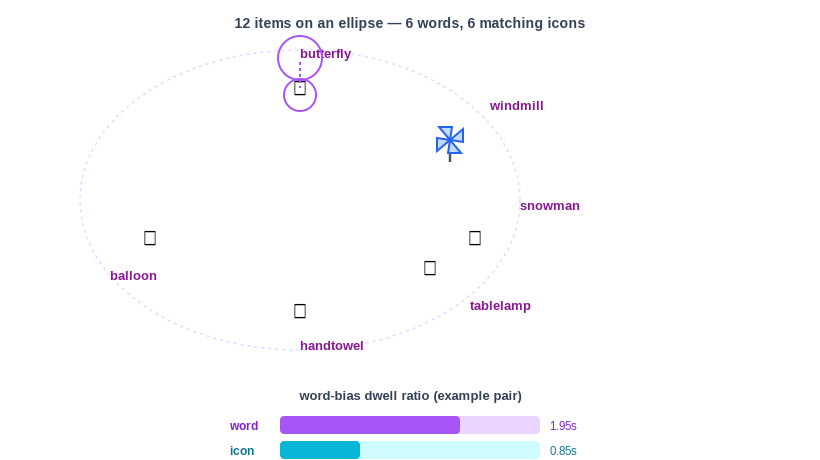
Twelve items — six written words and six corresponding pictures, drawn from a twelve-item, eight-language pool and selected six pairs per session — are arranged around an ellipse spanning the screen, each at one of twelve fixed angular positions thirty degrees apart. The subject's task is to match each word to its corresponding picture by gaze-guided selection: fixating a word, then fixating its matching picture, completes a pair. Twelve items at six pairs gives every session a mix of word-first and icon-first matching order, varied per session by random assignment of items to angular positions, so that screen-position effects (a word always appearing on the left, say) do not confound the dwell-time data collected.
3. Per-Slot Dwell-Time Accounting
3.1 The dwell radius
For each unmatched slot, every accepted gaze frame is tested against a per-slot capture radius: if the calibrated gaze point falls within that radius of the slot's screen position, the frame contributes to that slot's accumulating dwell time; a frame falling outside every slot's radius contributes to none. The platform additionally counts the number of times a previously-not-dwelling gaze stream transitions into a slot's capture radius (a fixation-onset count) and tracks each slot's total dwell time and onset count independently for its word half and its icon half.
3.2 The word-bias dwell ratio
The primary phonological marker derived from this task is the word-bias dwell ratio: the proportion of a matched pair's total recorded dwell time spent on the word label, relative to the time spent on the matched picture. A child who recognises a written word's meaning rapidly and automatically is expected to glance at it briefly before shifting attention to scanning for the matching picture, producing a low word-dwell ratio; prolonged word dwell — time spent re-reading or labouring over decoding the word itself, well past what is needed simply to identify which word it is — is the behavioural signature this task is designed to capture, on the rationale that phonological decoding difficulty manifests as exactly this kind of prolonged, effortful word inspection rather than the brief recognition glance a fluent reader exhibits.
3.3 The zero-dwell data-quality case
A pair matched correctly with near-zero recorded dwell on both the word and the icon is not, on its own, evidence of either very fast or very poor phonological processing — it is most often evidence that the gaze-capture radius for that pair's slots never registered the subject's actual fixation, despite the subject visibly attending to and correctly matching the pair. The platform's reporting layer treats this case as a data-quality caveat rather than a clinical finding, distinct from genuinely low (but non-zero) dwell, which is treated as the expected fluent-reading signature of §3.2.
4. Adaptive Dwell-Radius Gating
4.1 Why a single fixed radius is insufficient
A fixed capture radius, applied identically to every slot regardless of screen position, faces an unavoidable trade-off. Webcam-based gaze-calibration accuracy is not spatially uniform: the same calibration session typically shows markedly different accuracy in different screen regions, reflecting uneven sampling during the calibration procedure described in Thin-Plate Spline Gaze Calibration, this series. A radius wide enough to reliably capture genuine fixations in a poorly-calibrated screen region is, in a well-calibrated region, wide enough to create a second problem: on this task's ellipse layout, the closest two slots can be as little as roughly 190 pixels apart on a typical display, so a capture radius approaching or exceeding half that distance risks attributing a single fixation's dwell time to the wrong slot, corrupting the per-pair dwell data the task exists to collect.
4.2 Per-slot adaptive radius
The platform addresses this by deriving each slot's dwell-capture radius from the locally measured calibration accuracy at that slot's screen position, rather than applying one global radius. Using the eight validation points collected immediately after calibration (each with its own measured pixel error; see Leave-One-Out Cross-Validation, this series, for how that error is itself estimated), each of the task's twelve slot positions is assigned the error of its nearest validation point, scaled by a fixed safety multiplier and bounded within a floor and ceiling:
radius = clamp(nearestValidationError × 1.3, 100 px, 180 px)
A slot in a screen region where calibration was measured to be accurate receives a tight, low-cross-talk radius; a slot in a region where calibration was measured to be less accurate receives proportionally more tolerance, without ever exceeding the ceiling that bounds cross-slot attribution risk regardless of how poor the local calibration measurement is. When no validation data is available for a session (for instance, an older session predating this mechanism), every slot falls back to the previous fixed 150-pixel radius.
5. Discussion
The adaptive-radius mechanism in §4 is a direct application of a general principle: when a fixed threshold must serve simultaneously as a sensitivity bound (catch genuine fixations) and a specificity bound (reject cross-slot contamination), and the relevant uncertainty varies spatially across the measurement domain, a single global threshold is dominated by a spatially-varying one wherever the underlying uncertainty estimate (here, per-region calibration error) is itself available — which, in this platform, it already is, as a side effect of the validation phase every calibration session already performs. The residual limitation is that the validation phase samples only eight screen positions, so the nearest-validation-point assignment is itself an approximation; a denser validation grid would sharpen this further at the cost of a longer calibration procedure, a trade-off not currently judged favourable given the attention-span constraints already discussed in §1.
6. Conclusion
By recording per-slot, per-half (word vs. icon) dwell time during a naturalistic matching game, deriving a word-bias dwell ratio as the primary phonological-decoding marker, and gating dwell attribution with a per-slot capture radius adapted to locally measured calibration accuracy rather than one fixed global radius, this task extracts lexical-access timing data from an activity that is, from the subject's perspective, simply a picture-matching game.
References
- Rayner, K. (1998). Eye movements in reading and information processing: 20 years of research. Psychological Bulletin, 124(3), 372–422.
- Just, M. A., & Carpenter, P. A. (1980). A theory of reading: from eye fixations to comprehension. Psychological Review, 87(4), 329–354. [Eye-mind hypothesis underlying dwell-as-processing-time interpretation]
- Salvucci, D. D., & Goldberg, J. H. (2000). Identifying fixations and saccades in eye-tracking protocols. Proceedings of the 2000 Symposium on Eye Tracking Research & Applications, 71–78.
Appendix A — Ellipse Layout Geometry
Twelve slots at thirty-degree angular spacing on an ellipse with horizontal radius ≈38% and vertical radius ≈34% of viewport dimensions; minimum inter-slot spacing (at the ellipse's narrow ends) ≈190 px on a 1920×1080 display, rising to ≈377 px near the ellipse's wide ends — the spacing figures motivating the 180 px adaptive-radius ceiling in §4.2.
Appendix B — Adaptive Radius Reference Table
| Nearby validation error | Computed radius (clamped) |
|---|---|
| 50 px | 100 px (floor) |
| 100 px | 130 px |
| 140 px | 182 px → 180 px (ceiling) |
| 250 px | 180 px (ceiling) |